



Matcha and mindfulness: why they pair so well
The Japanese tea ceremony was never just about drinking tea. Preparing matcha slowly, attending to each step, and drinking it without distraction is itself a form of mindfulness practice — one that predates the word mindfulness by several centuries. There is a scientific reason this works, and it has to do with L-theanine.

L-theanine and the alpha state
Meditation is associated with increased alpha wave activity in the brain — a state of relaxed, present-moment awareness, neither drowsy nor agitated. L-theanine, the amino acid found in high concentrations in matcha, has been shown in EEG studies to produce the same alpha wave pattern within 30–40 minutes of ingestion (Nobre, Rao & Owen, 2008). You do not need to meditate for this to happen; the compound shifts the brain towards that state independently.
What this means in practice is that drinking matcha before sitting to meditate may make the initial settling easier. The distraction of trying to slow down an active mind is reduced, not by sedation but by a gentle neurochemical nudge towards the state you are trying to cultivate anyway.
Sipspa
The matcha Sipspa sources from Kyushu, Japan is shade-grown to concentrate L-theanine — the compound most studied for promoting calm attention without sedation. That is the practical grounding beneath the longer tradition of preparing matcha with care and intention.
Focus without agitation
Matcha also contains caffeine, but L-theanine and caffeine together produce a different effect than caffeine alone. Dodd et al. (2015) found in a placebo-controlled study that the combination improved cognitive performance and sustained attention compared to either compound alone, while the anxiety and jitteriness associated with caffeine were reduced.
For mindfulness practice, this matters. Meditation requires presence and attention, not stimulation. Matcha supports the former without tipping into the latter. A cup 20–30 minutes before sitting works well as a pre-practice ritual for this reason.

The preparation as practice
The Japanese tea ceremony — chado — is a study in attending to small things. Sifting the matcha, heating the water to the right temperature, whisking in a steady W pattern, holding the bowl with both hands. None of these steps is complicated. But each one requires your attention, which means that for the few minutes you are making matcha, you are not elsewhere. That is, more or less, the definition of mindfulness.
You do not need a full ceremony. The basic preparation — sift, whisk, drink slowly — takes three or four minutes and provides the same quality of attention that any deliberate ritual does. Over time, the act of making matcha can become a reliable cue that settles the nervous system before the day gets moving.
Mood and cognitive performance
Dietz, Dekker & Piqueras-Fiszman (2017) ran an intervention study specifically using matcha — both as a drink and in a snack bar format — and measured effects on mood and cognitive performance. Both formats produced improvements in attention and reaction time compared to placebo. Mood effects were more variable but present. This is one of the relatively few studies using actual matcha rather than isolated green tea extract, which makes it particularly relevant.
For a mindfulness or meditation practice, a positive baseline mood and sharper attention are not trivial. The quality of a session is affected by what state you bring to it. Matcha does not replace the practice, but it may make the practice more accessible on days when it otherwise is not.
Building a simple matcha ritual
A few practical options, depending on where matcha fits into your existing routine:
Before sitting to meditate
Prepare a cup slowly, drink it without your phone, and then sit. The preparation transition — from kitchen to cushion — is itself a useful ritual boundary. The L-theanine will be active within 30 minutes.
As a break within a long session
For longer sits or extended practice days, a short matcha break can restore focus without the disruptive energy of coffee. Keep it small — 2g in 70ml — so the volume is not distracting.

Paired with yoga or mindful movement
Matcha before a morning yoga session works well. The focus and relaxed alertness it produces suits slow, deliberate movement. Avoid drinking it immediately before vigorous practice — let it settle first.
As the morning ritual itself
For many people, the matcha preparation is the mindfulness practice. Making it with care, drinking it quietly before the day starts — this is a form of daily ritual that requires nothing else. Simple and repeatable habits often do more than elaborate ones.
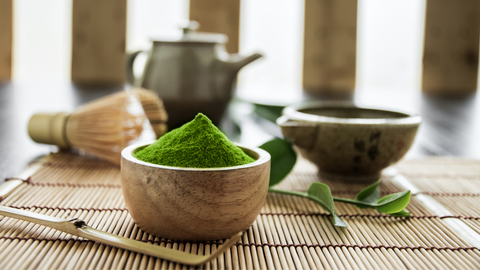
Matcha and mindfulness reinforce each other in ways that are grounded in research, not just tradition. L-theanine supports the neurological state that meditation cultivates. The preparation itself is a practice. Used consistently, it becomes part of the texture of a calmer day. If you want to start or deepen that ritual, our matcha is single-origin from Japan, single-ingredient, always the latest harvest.
Sources
- 1. Nobre, A. C., Rao, A., & Owen, G. N. (2008). L-theanine, a natural constituent in tea, and its effect on mental state. Asia Pacific Journal of Clinical Nutrition, 17(S1), 167–168.
- 2. Dodd, F. L., et al. (2015). A double-blind, placebo-controlled study evaluating the effects of caffeine and L-theanine both alone and in combination on cerebral blood flow, cognition and mood. Psychopharmacology, 232(14), 2563–2576.
- 3. Dietz, C., Dekker, M., & Piqueras-Fiszman, B. (2017). An intervention study on the effect of matcha tea, in drink and snack bar formats, on mood and cognitive performance. Food Research International, 99, 72–83.
- 4. Okakura, K. (1906). The Book of Tea. Fox Duffield.
Leave a comment